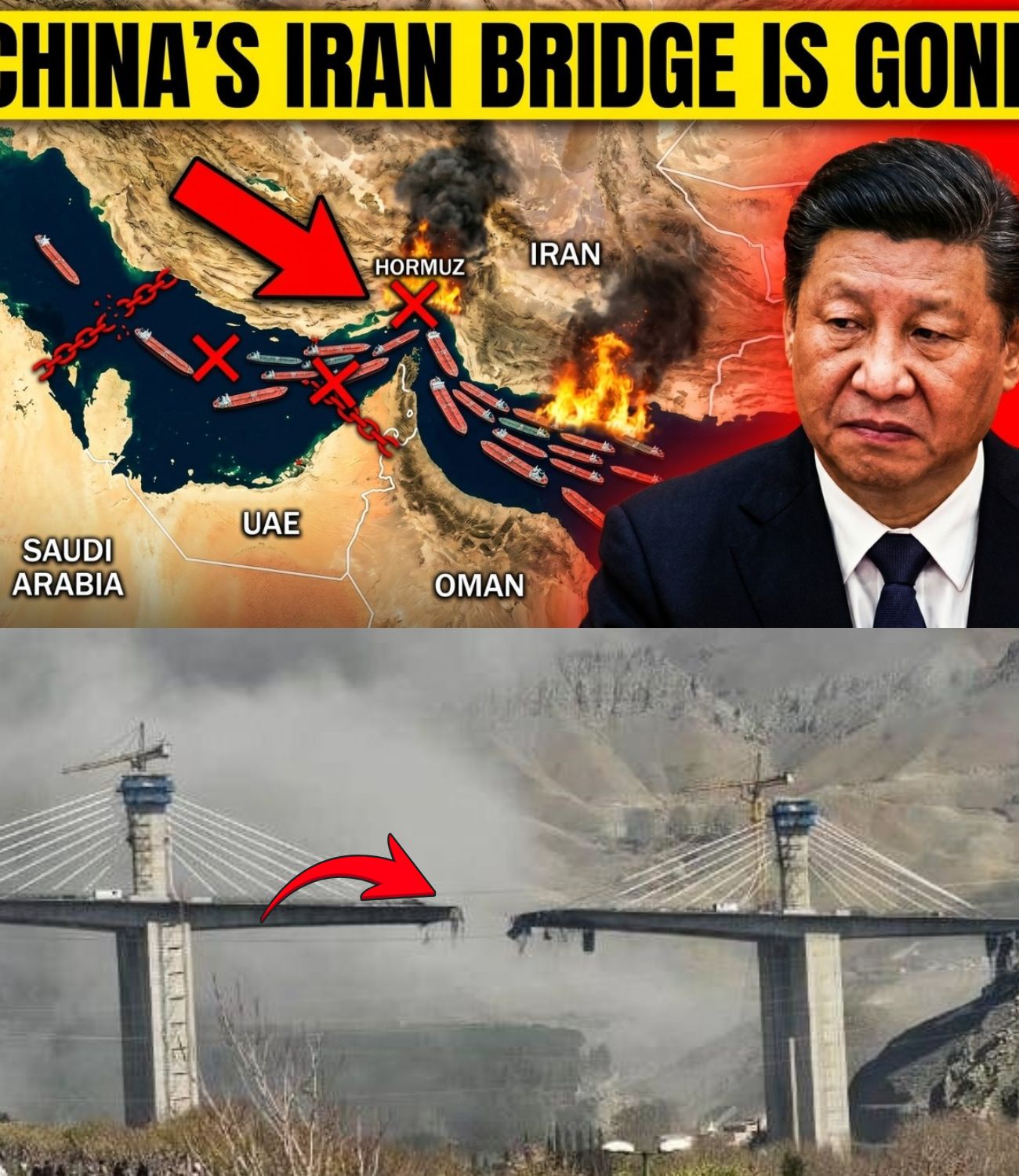
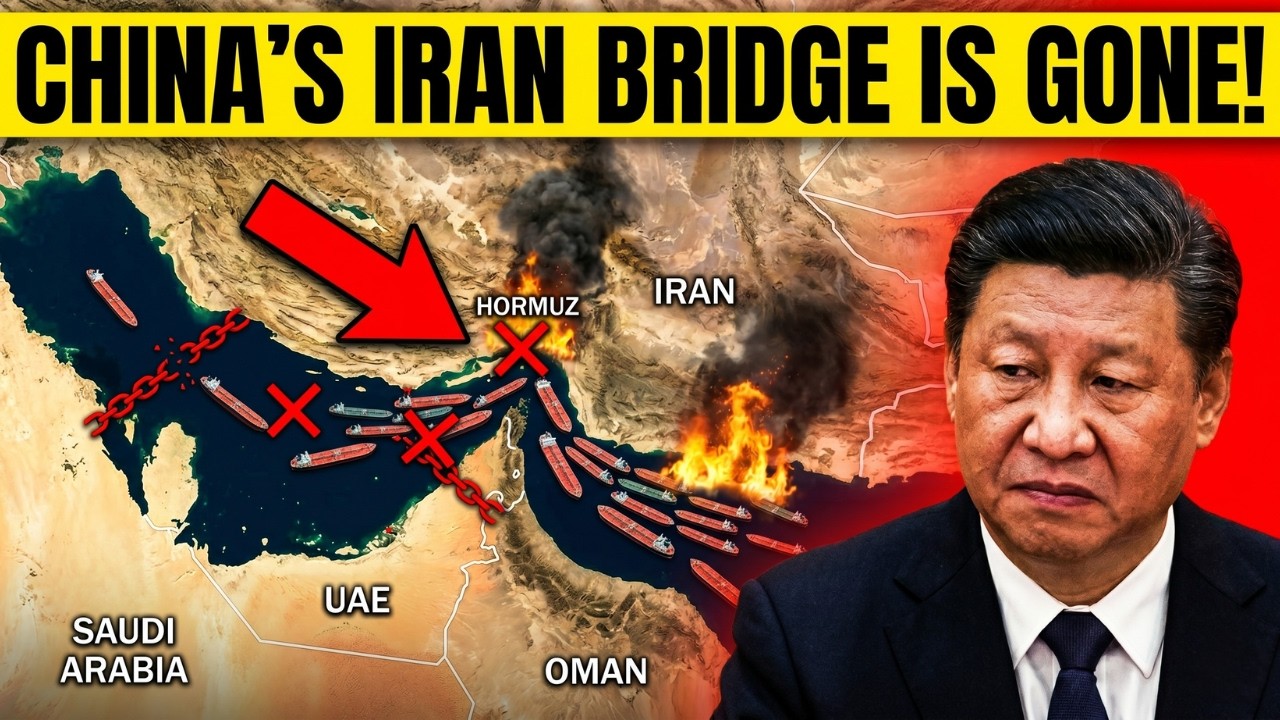
China’s Iran Bridge Is Gone! Xi Jinping Become POWERLESS as Hundreds of Tankers Stuck in Hormuz
“Hey everybody, it’s today, April 29th, 2026, and we are covering one of the most underreported dimensions of the entire Iran war because everybody is focused on Tehran. Everybody is watching the IRGC, the blockade, the nuclear negotiations. But I spent the last two days going deep on a country that has not had a single bomb fall on its territory, has not fired a single shot in this war, and yet is absorbing one of the most strategically devastating blows of the entire conflict.
That country is China. And what I found when I looked at this from every angle across the diplomat’s analysis, Bloomberg’s reporting, the Hudson Institute’s strategic assessment, the Jerusalem Post’s economic breakdown, and Wikipedia’s documented timeline of the Hormuz crisis is a story of a decade-long silent empire collapsing in real time.
Xi Jinping built an entire global power architecture around Iran. And the US, without dropping a single bomb on Chinese soil, has just demolished it. Let me start where this story actually begins because to understand what is happening to China right now, you have to understand what China built in Iran over the last decade. The 2021 China-Iran comprehensive strategic partnership valued at $400 billion was designed to secure Iranian energy and infrastructure for a full quarter century.
Iran was envisioned as the indispensable land bridge for the China-Central Asia-West Asia economic corridor, the absolute spine of Xi Jinping’s Belt and Road Initiative westward expansion. Think about what that actually looked like on the ground. Chinese companies were developing Iran’s mineral base. CNPC was operating at the South Pars gas field.
Huawei was building Iran’s telecommunications infrastructure at the Chabahar and Jask ports. Ports constructed with Chinese investment were designed as exclusive oil export routes to Beijing that would completely bypass the Strait of Hormuz. And Iran’s shadow fleet carrying discounted crude oil on a conveyor belt directly to Chinese refineries had become one of the most important hidden energy pipelines on the planet.
China was buying roughly 90% of Iran’s oil exports, providing a financial lifeline to the heavily sanctioned regime. But when US and Israeli strikes began to pummel Iran starting February 28th, 2026, Beijing showed little support for Tehran’s defense beyond criticizing the attacks. That detail matters enormously. China built a $400 billion strategic partnership with Iran.
And when Iran needed its most powerful partner to do something, anything, Beijing issued a press statement—that tells you everything about the true nature of what China built in Iran. It was not a strategic alliance. It was a resource extraction arrangement disguised as friendship. And when the extraction chain broke, the friendship vanished with it.
China’s entire Middle Eastern architecture has suffered a fatal blow. The chaos in Tehran transforms what was a strategic asset into a massive investment black hole. Billions in committed capital spanning telecommunications to transit networks are now at risk of becoming toxic assets. And here is where the Hormuz blockade turns from Iran’s problem into China’s nightmare.
China’s foreign ministry called the US blockade of Iranian ports a dangerous and irresponsible act. Foreign Ministry spokesman Guo Jiaken said:
“Only a full ceasefire can ease the situation. Beijing would make efforts to help restore peace and stability in the Middle East.”
Efforts. That was China’s response. Not ships, not pressure, not leverage—efforts. While 34 vessels were being turned back by US destroyers, while Chinese-bound tankers were being intercepted, while the cheap Iranian oil pipeline that had been feeding Chinese refineries for years ran completely dry, Beijing offered efforts.
The shadow fleet that moves Iranian oil was built for exactly this game: false flags, spoofed transponders, and ship-to-ship transfers off the coast of Malaysia. China’s customs records show zero imports from Iran since 2022. Yet, its recorded Malaysian crude imports in 2026 have reached 1.3 million barrels per day, more than double Malaysia’s entire production.
That number should make you stop and reread it. 1.3 million barrels per day labeled as Malaysian, actually Iranian. That is the scale of the covert energy bridge Beijing built and depended on. And now every vessel trying to run that route is being hunted. On April 19th, 2026, US forces seized the sanctioned Iranian container ship MV Tusca in the Gulf of Oman on a return voyage from China, reported to be carrying dual-use equipment.
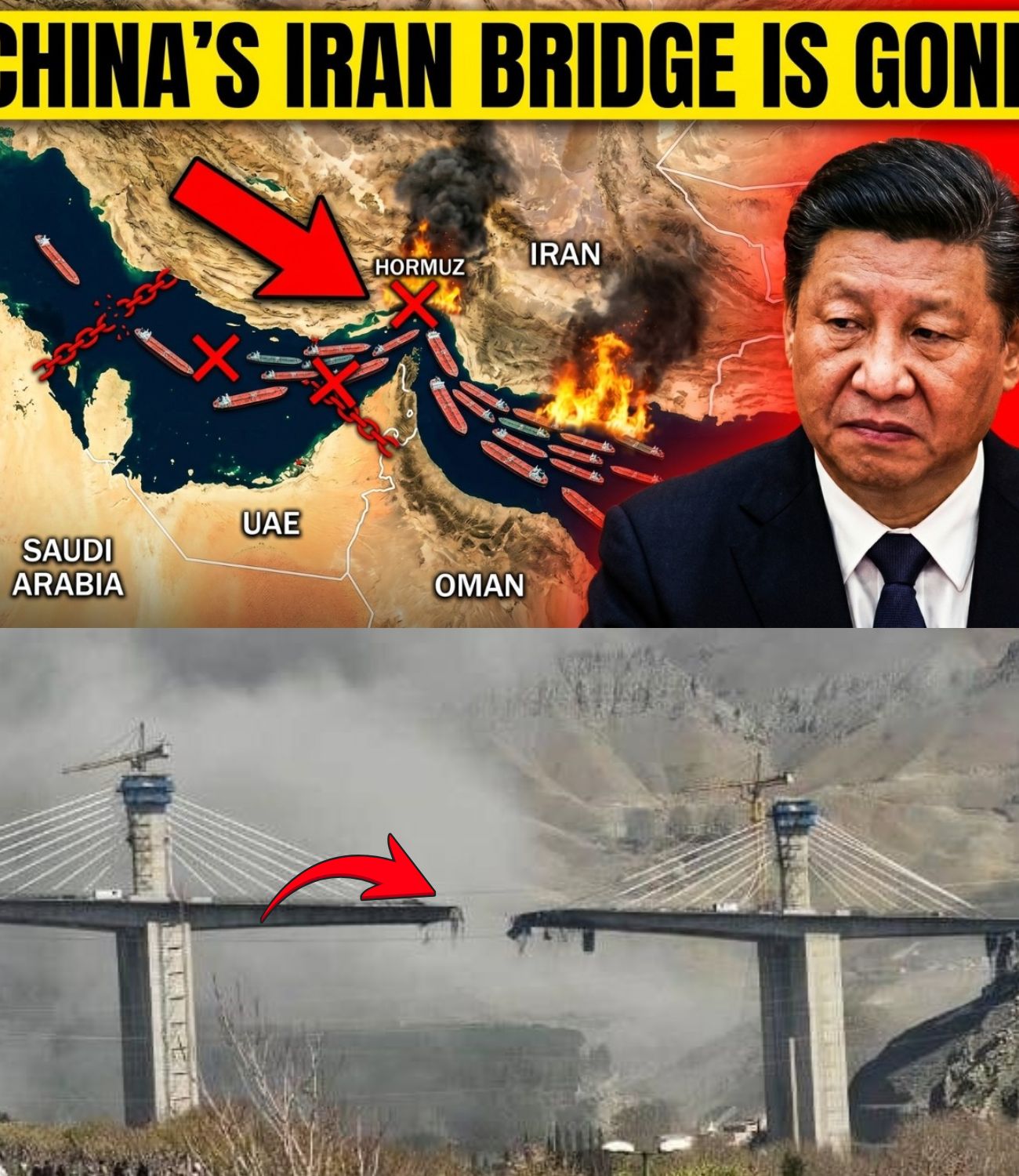
The US is not just blockading Iran’s ports. It is hunting the entire shadow network that kept China’s cheap energy flowing. The bridge is gone, and a billion barrels in strategic petroleum reserves—enough for roughly 120 days. On the surface, that sounds like a buffer. But 120 days is not a solution. It is a countdown.
And with the Belt and Road’s central node in flames, with the shadow fleet being seized in real time, and with the US Navy demonstrating that it can cut China’s energy lines at the source without a single act of war against China directly, what exactly does Xi Jinping do next? Because from what I researched, China’s options are far fewer and far weaker than Beijing has ever been willing to admit.
Now I want to take you inside the Chinese economy itself because this is where the story stops being about geopolitics and starts being about something far more uncomfortable for Beijing: real factories, real workers, real supply chains breaking in real time. And what I found when I looked at the actual on-the-ground economic data coming out of China in April 2026 is something that Xi Jinping’s state media is working very hard to hide.
The fortress economy is cracking from the inside and the cracks are widening every single week that the Hormuz blockade holds. Let me start with the number that should be the headline of every business newspaper on Earth. China’s oil imports from the Gulf, now trapped in the Strait of Hormuz, amount to at least 5.4 million barrels per day flowing to China through Hormuz.
Russia exported around 300,000 extra barrels per day to China in January and February, up to around 2.1 million barrels per day total. In other words, Chinese imports from the Gulf are more than double what it receives from Russia. So when people say China can just pivot to Russian oil, that is mathematically impossible.
Russia does not have the pipeline capacity. Russia does not have the tanker fleet. And Russian oil by sea also transits through straits that the US Navy could theoretically interdict. China stockpiled aggressively in anticipation of this crisis. But stockpiles are not a strategy. They are borrowed time. And borrowed time is running out.
Now look at what is actually happening on the factory floor. Chinese auto plants produced 27% fewer cars in the first two weeks of April compared to the same period last year. According to Alicia Garcia Herrera, chief economist for Asia-Pacific at Natixis, the economy is slowing and China may struggle to meet its annual growth target of 4.5% or higher.
27% fewer cars in two weeks. And that is the automotive sector, which is one of China’s most critical strategic industries—the one Beijing has been betting its entire future economic transition on. Electric vehicles, semiconductors, next-generation manufacturing, all of it depends on inputs that are either coming through Hormuz or being made more expensive by the energy shock radiating from the blockade.
And then there is the story that broke just yesterday, April 28th, that I genuinely could not believe when I first read it. In southern China, thousands of workers staged protests after factories abruptly shut down on April 20th. The closures followed a sharp increase in plastic prices amid disruptions to shipping through the Strait of Hormuz.
Workers hung banners on factory gates reading:
“Return my blood and sweat money.”
Videos circulating on Chinese social media showed protesters standing quietly while police monitored the scene. Workers in Yulin, China, protesting outside shuttered factories. In a country where public protest carries enormous personal risk, workers were still out there with banners.
That tells you exactly how severe the economic pressure has become at the ground level. Because those factories did not close because of a distant geopolitical abstraction. They closed because plastic prices surged after shipping through Hormuz was disrupted and the margins disappeared overnight. Half of the world’s seaborne trade in sulfur—a vital industrial input—flows through the Strait of Hormuz.
The disruption to petrochemical complexes and fertilizer supply has raised global food prices. The damage to aluminum in Bahrain and the Emirates created a shortage of automotive-grade aluminum for manufacturers including Toyota, Nissan, BMW, and Hyundai. And every one of those disruptions hits China harder than it hits anyone else because China sits at the center of every one of those supply chains.
Chinese manufacturers need aluminum for EVs. They need sulfur for industrial processing. They need petrochemical inputs for the plastics that go into everything from toys to electronics to packaging. When the Hormuz crisis chokes those flows, it is not just a commodity story. It is an existential pressure on China’s manufacturing cost base—the single competitive advantage that Xi Jinping’s entire economic model has been built on.
Shortages of industrial inputs could make it more difficult for China to meet its 2026 growth target of 4.5 to 5.0%, already the lowest since the early 1990s. A longer war that slows global growth is a bigger risk given China’s deep dependence on exports. Lowest growth target since the early 1990s.
And now on top of a slowing economy they were already struggling to stimulate, you have the Hormuz blockade cutting their cheapest energy supply, the Belt and Road’s most important node in flames, and raw material costs spiking across every sector simultaneously. And here is the dimension nobody is talking about enough.
In April 2026, the US sanctioned one of China’s largest teapot refineries, Hengli Petrochemical Dalian refinery, for processing Iranian crude oil. A teapot refinery in China, sanctioned directly by Washington. That is not a warning shot. That is the US telling Beijing in the clearest possible language:
“We know exactly which facilities are processing Iranian crude. We know exactly how your shadow fleet works and we are prepared to reach inside China’s own industrial infrastructure to apply pressure.”
And Beijing’s response? China’s foreign minister spokesman told a press conference that:
“Beijing would make efforts to help restore peace and stability in the Middle East and urged all parties to abide by the ceasefire arrangements.”
Efforts again. Now, I want to show you something about China’s Belt and Road that changes the entire frame of how we should understand this crisis. The strategic consequence of the Iran war is the collapse of core Belt and Road assumptions. It shows that security risks threaten infrastructure, that neutrality is hard to maintain, and that investments are exposed to military escalation.
Let me translate that from academic language into plain English. China spent more than $269 billion building infrastructure across the Middle East since 2005. Ports, pipelines, highways, power plants. The implicit promise to every country that signed on to Belt and Road was:
“China is a stable, reliable partner that can deliver economic development without the political strings that come with Western investment.”
That was the pitch. That was the brand. And then Iran, China’s flagship Belt and Road partner, its most strategically critical node, the anchor of the entire westward expansion strategy, got its leadership decapitated on February 28th. And Beijing did nothing.
When the UAE joined a US-led alliance and called for the strait’s opening while Beijing remained silent on the weaponization of a vital energy route, the damage deepened. Gulf monarchies now understand what China’s security cooperation means when Iranian attacks affect their own territory. Every Gulf state that signed Belt and Road agreements, every country from Pakistan to Indonesia to Central Asia that trusted China’s promise of economic connectivity and strategic reliability—they are all watching right now.
They are watching Beijing watch Iran burn. And they are asking themselves the question that China has spent two decades trying to prevent anyone from asking when it actually matters:
“Is China a reliable partner or just a buyer of cheap resources?”
That question once asked openly cannot be answered with another infrastructure contract. And from everything I am seeing across the data, the reporting, and the market reactions right now on April 29th, 2026, it is being asked loudly in Jakarta, in Riyadh, in Islamabad, in Nairobi. The fortress economy is not just cracking from the Hormuz blockade. It is cracking from the collapse of the trust architecture that held the entire Belt and Road together.
And that structural damage will outlast this war by decades. Now we get to the dimension of this story that Beijing finds most terrifying of all. And it is not the current economic pain. Pain can be managed. Stockpiles can be burned through. Alternative suppliers can be found at higher prices. What China cannot manage, what cannot be strategically absorbed, is the lesson that the United States just taught the entire world by closing Hormuz.
Because the lesson of Hormuz is not really about Iran. The lesson of Hormuz is about China. And every strategic planner sitting in Beijing right now, every admiral, every economist in the Politburo has spent the last six weeks staring at one word that former Chinese President Hu Jintao first used in 2003—a word that has defined China’s greatest strategic nightmare ever since: Malacca.
Let me give you the geography first because it matters enormously. The Strait of Malacca, located between Sumatra Island in Indonesia and Peninsular Malaysia, accommodates more than 60,000 vessels annually, representing approximately 25% of global maritime trade, including roughly 80% of China’s imported crude oil. 80% of China’s oil imports through a single narrow waterway just 3 km wide at its narrowest point near Singapore.
And the US has military bases positioned at both ends of it: Diego Garcia in the Indian Ocean, Singapore, Japan, Guam. The entire architecture of American naval power in Asia is built around the ability to pressure that strait. The confrontation between the US and Iran over the Strait of Hormuz has shown how easily choke points can be militarized and how quickly economic fallout can spread.
The same logic applies to Malacca, except here the consequences would cut to the heart of Asia’s economies. Washington has far greater capacity to project power in this area than China does thanks to its naval reach and networks of allies and partners. The Iran war has underscored Beijing’s Achilles’ heel. And this is the sentence that Chinese strategic planners cannot stop reading right now:
“The US just demonstrated in real time with live naval assets and active enforcement that it can close a strategic strait against one of the most militarized regimes on Earth while keeping global trade flowing for everyone else, while keeping oil prices manageable for its own allies, and while maintaining full deniability that it is targeting any specific nation’s trade.”
It is the cleanest, most precise economic weapon ever deployed in modern history. And Beijing just watched the entire playbook unfold from the front row. A research fellow at East China University specializing in diplomacy and security, Jin Guo, argued in the South China Morning Post that:
“The US war with Iran reflects Washington’s increased focus on a global maritime blockade strategy.”
He warned that the US will likely intensify its focus on the world’s busiest shipping straits to stifle Beijing’s development, calling it an “unchangeable reality” that the US is seeking to end the Iran conflict in order to focus entirely on containing China.
An unchangeable reality. That is not opposition commentary. That is a Chinese academic publishing in a Chinese-affiliated newspaper telling the Chinese government what it needs to hear. The Iran war was not just about Iran. It was a demonstration, a proof of concept, a live-fire test of the exact mechanism that could strangle China if US-China tensions over Taiwan ever tip from competition into confrontation.
And here is what makes this even more acute right now. Indonesia’s finance minister floated the idea of mimicking Iran’s taxes on the Strait of Hormuz for ships sailing the Strait of Malacca, saying:
“Indonesia is not a peripheral country and sits on a strategic global trade route.”
Indonesia, one of the three countries that borders and manages the Strait of Malacca. The country that the US has been actively deepening military ties with through the exact same period as the Iran war. That conversation, even after the foreign minister walked it back, sent shockwaves through shipping insurance markets.
The Trump administration is now harvesting results in Asia. The strategic focus has shifted from the Strait of Hormuz to the Strait of Malacca through which most of China’s energy imports flow. The Hudson Institute’s assessment is direct: Washington won the Hormuz battle; now the chessboard is moving east. And China’s options here are genuinely frightening to contemplate if you are sitting in Beijing.
Because I went through every realistic response and every single one leads somewhere Beijing does not want to go. Military confrontation at Malacca would mean a direct hot war with the United States at a moment when China’s economy is already absorbing the Hormuz shock, when its credibility has just been shattered, and when it is watching Iran, its most important strategic partner, implode from within.
Beijing is rapidly trying to mitigate its Malacca dilemma. Electric vehicles are slowly diminishing Chinese transportation fuel demand. Chinese gasoline consumption has already peaked. Chinese diesel demand is also increasingly facing structural pressure as sales of battery-electric heavy-duty vehicles nearly tripled in 2025.
This is China’s long-game answer to Malacca. Reduce the dependency by electrifying the economy. Less oil needed means Malacca matters less as a pressure point. But this strategy plays out over years and decades. It does not help when the blockade is happening right now and the 120-day petroleum reserve clock is ticking.
And then there is the Taiwan dimension, which is the one nobody in Beijing wants to say out loud, but everyone is calculating. In the event of a conflict, particularly over Taiwan, the United States could interdict oil shipments to China by disrupting maritime routes through the Strait of Malacca. Before Hormuz, this was a theoretical threat, a war game scenario, something discussed in think tanks and security papers.
After Hormuz, it is a proven capability demonstrated against a real adversary in real time. The US has the ships. The US has the positioning. The US has the precedent. And if China moves on Taiwan, the question Beijing now has to answer is not: “Could the US blockade Malacca?” but: “How quickly could they do it? And how long could we hold out?”
Xi Jinping will clearly realize in negotiations that Washington has weakened his proxies, shut down his laboratory in Iran, and destroyed the military system he spent a decade building. Beijing will be the next core of accountability. According to the Hudson Institute’s strategic assessment, “laboratory”—that is the word that matters most in that sentence.
Iran was not just a partner for China. It was a testing ground, a place where China refined its techniques for bypassing sanctions, for building shadow financial networks, for moving military technology through the gray zones of international commerce. US intelligence documented Chinese cargo ships unloading sodium perchlorate in Bandar Abbas—enough to produce roughly 800 new missiles.
Chinese firms linked to the People’s Liberation Army marketed geospatial intelligence about US forces in the region. The laboratory is now destroyed. The techniques are now exposed. The shadow networks are being systematically dismantled through secondary sanctions on Chinese banks and tanker seizures from the Indian Ocean to the Bay of Bengal.
And here is the underreported reality that I think will define the next decade of US-China competition: What the US demonstrated in Iran is that it does not need to attack China to hurt China. It does not need to fire a shot at a Chinese vessel to reshape Chinese strategic calculations. It simply needs to control the choke points.
And right now, on April 29th, 2026, the US controls every single choke point that China depends on: Hormuz, the approaches to Malacca, the Bay of Bengal, the Indian Ocean transit lanes. China’s fortress economy was never as fortress-like as Xi Jinping marketed it because a fortress with all its supply lines exposed to a rival’s naval power is not a fortress. It is a siege waiting to happen.
So here we are, the final section, April 29th, 2026, and I want to be completely straight with you about what I think is the most important takeaway from everything we have covered. Because the real story of China and the Hormuz crisis is not just about what has already happened. It is about the decision tree Beijing is staring at right now in real time, where every single branch leads somewhere deeply uncomfortable.
I researched China’s options thoroughly across energy analysts, strategic think tanks, naval experts, and economic forecasters. And what I found is that for all of Xi Jinping’s projections of power, for all the fortress economy rhetoric and the Belt and Road grandeur, Beijing is sitting at this moment with almost no good cards to play.
Let me lay out the reality of China’s position as of today. China probably has 60 to 90 days of practical working time before refiners must start cutting production runs to protect working minimum stocks. That is the time clock leaders in Beijing must work against. The optimal strategy right now is to absorb the shock, scale substitutes, and avoid escalation unless forced by directed US interdiction of Chinese vessels.
60 to 90 days. That is the window, not the 120-day reserve figure that state media keep citing, because raw reserve numbers do not account for the accelerated consumption rate, the reduced incoming supply, and the industrial demand that cannot simply be switched off without triggering the exact kind of factory shutdowns and worker protests we already saw this week in Yulin.
The clock is not just ticking, it is accelerating. And what is Beijing’s response to this ticking clock? On April 21st, during a call with Saudi Crown Prince Mohammed bin Salman, Xi Jinping said:
“The Strait of Hormuz should remain open to normal navigation, which is in the common interest of regional countries and the international community.”
The Strait of Hormuz should remain open. That is Xi Jinping, the leader of the second most powerful nation on earth, the man who commands the world’s largest navy by ship count, calling for Hormuz to remain open in a phone call with a Saudi prince. He is not opening it. He is not threatening to open it. He is asking for it to be open.
That sentence in a diplomatic phone call is the clearest possible signal of Beijing’s actual leverage in this crisis, which is to say, far less than the decade of fortress economy marketing led anyone to believe. China is pursuing a policy of “active neutrality,” adopting a balanced position. It emphasizes the necessity of keeping the strait open in its own interests while maintaining a special relationship with Iran and avoiding direct confrontation with Washington.
Beijing has expressed its rejection of the US embargo, deeming it dangerous and irresponsible, while indicating readiness to challenge Washington diplomatically and economically to protect its interests. China is also exploiting the current crisis to increase the use of the Chinese Yuan in purchasing Iranian oil, aiming to undermine the dollar’s dominance.
Active neutrality. That is the phrase China’s own analysts are using to describe its strategy. It is a careful, face-saving way of saying Beijing is doing everything possible to protect its interests without triggering a direct military confrontation with the United States. And the Yuan-for-oil angle is real, but it is also not the lever it appears to be. You cannot buy oil you cannot ship; Yuan payments on stranded tankers are a financial maneuver without an underlying physical reality.
And then Beijing did something revealing on April 16th while everyone was watching Hormuz. While US efforts were occurring to reopen the Strait of Hormuz, China moved to block the Scarborough Shoal in the South China Sea. The Scarborough Shoal—Chinese Coast Guard vessels blocking the disputed reef that the Philippines has been contesting for years.
Think about why Beijing chose that moment to make that move. It was not a coincidence. When a major power is losing leverage in one theater, it tends to flex in a theater where it still holds advantage. China cannot challenge three US carrier strike groups in the Arabian Sea, but it can send Coast Guard vessels to a reef in the South China Sea and reassert presence where its military edge is less contested.
That move tells you everything about Beijing’s psychological state right now: it is compensating, demonstrating strength in a place where strength is still available because in the place that actually matters for its economy, Hormuz, it has none. China stepped in as an international mediator following the collapse of the Islamabad peace talks.
Xi Jinping proposed a four-point initiative for peace and stability in the Middle East in mid-April 2026, presenting China as a peace partner focused on economic dialogue. In contrast to Western military alliances, China is attempting to leverage its past diplomatic successes to solidify its role as a mediating power capable of addressing the root causes of conflicts through development rather than force.
Four peace points from the country that built a $400 billion strategic partnership with the regime that started this entire crisis. China’s mediation play is not without logic. If Beijing can position itself as the responsible adult in the room, as the power that resolved the crisis diplomatically while America and Israel used bombs, it recovers some of the geopolitical prestige it lost when Iran collapsed.
But here’s the outcome: the Strait of Hormuz crisis will determine the shape of the future economic partnership or confrontation between the two countries. That summit is the moment everything converges: nuclear deal, Hormuz-Malacca threat, Belt and Road credibility, Taiwan calculations, secondary sanctions on Chinese refineries, Iranian tanker seizures—all of it arrives at that table simultaneously.
And Beijing knows that it is walking into that summit from a position of structural weakness that its own public statements cannot disguise. The fortress economy cracked. The Iran bridge is gone. The shadow fleet is being hunted. The Belt and Road’s most important node is in ruins. And the US has just proven to the entire world—and most importantly to Xi Jinping himself—that it can cut China’s cheapest energy supply without firing a single shot at a Chinese vessel, without declaring war on China, without even mentioning China’s name in the official blockade orders.
That is the most sophisticated application of economic warfare in the modern era. And China, for all its strategic planning, for all its decades of building alternative routes and diplomatic cover and shadow financial networks, was not prepared for it at this scale and at this speed. Here is my honest final assessment.
China is not broken by this crisis. Goldman Sachs still projects 4.8% growth in 2026. The reserves will last long enough for a negotiated resolution if one comes. Beijing is too strategically disciplined to do something reckless like a direct naval confrontation over Iranian tankers. But the damage is real, lasting, and structural in ways that go far beyond this particular crisis.
Every country watching from the Global South now knows that China’s security guarantees are words on paper when American military power enters the equation. Every Belt and Road partner is quietly reassessing the reliability of Chinese commitments. Every factory owner dependent on cheap energy inputs from the Gulf is asking whether the supply chain they built around Chinese manufacturing is as stable as it once appeared.
And for Xi Jinping personally, this is the moment his decade of fortress economy rhetoric collided with the reality of what a US naval blockade actually looks like when it is enforced with three carrier strike groups, P-8 Poseidon reconnaissance aircraft, and submarines in the Indian Ocean. Not invincible, not insulated, not fortress-like at all.
Just a very large economy with very exposed supply lines and a rival that now knows exactly where every one of those lines runs. That is the real story behind the Hormuz crisis that nobody is telling you loudly enough. Drop your thoughts in the comments below. Is China more vulnerable than it projected? Or does Beijing still have cards nobody has seen yet? I want to read every one of your takes.”