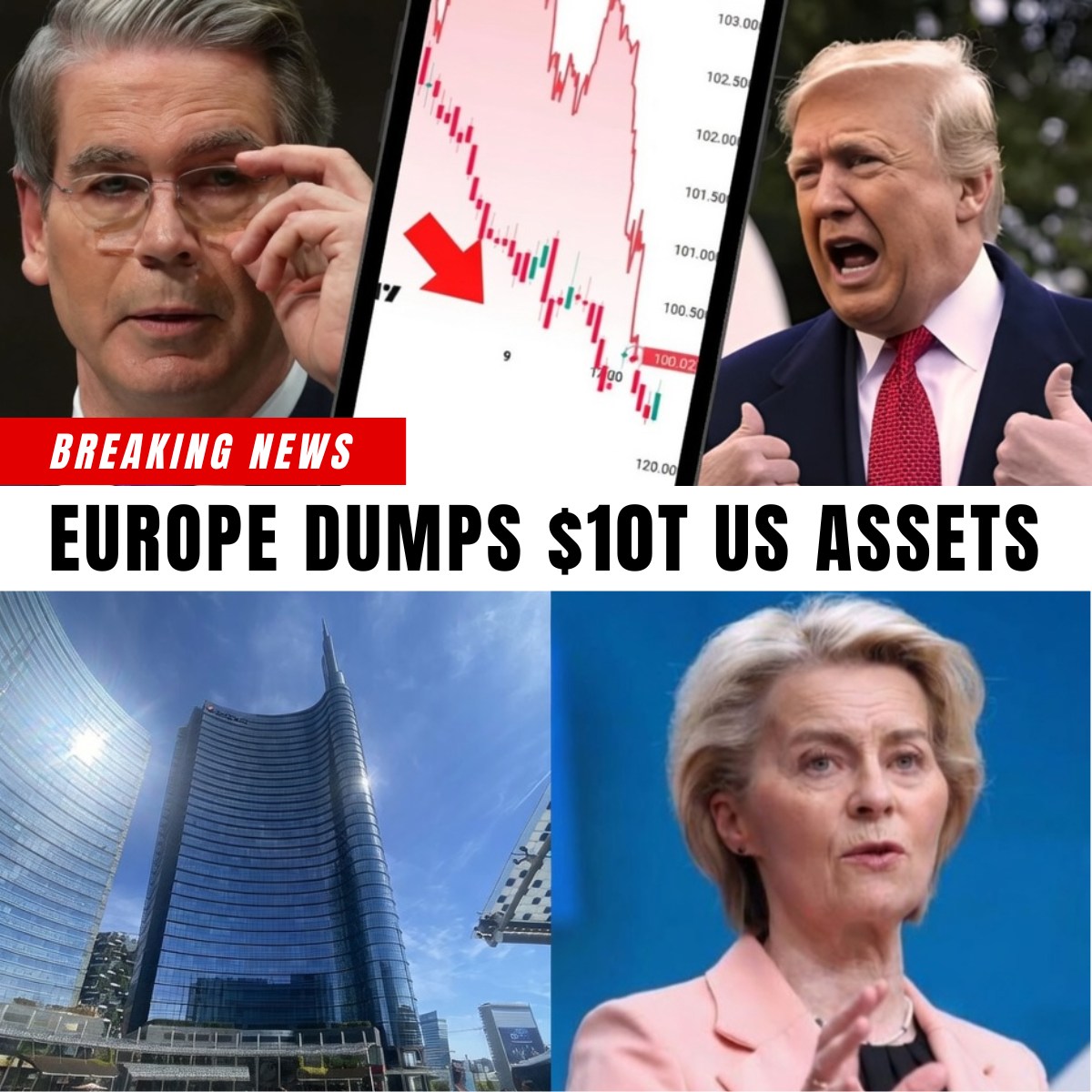
The $10 Trillion Exodus: Europe Triggers Massive Divestment from US Assets as Strategic Autonomy Becomes Reality… habibi
For decades, the financial relationship between Europe and the United States was seen as the bedrock of global stability. European capital flowed into American stocks, bonds, and real estate, while US asset managers saw their market share in Europe surge to nearly 47% by 2026. However, a seismic shift is currently underway. A massive reallocation of capital, totaling an estimated $10 trillion, is being pulled from US assets as European institutions pivot toward a strategy of “strategic autonomy.” This is not a temporary market rebalancing; it is a systematic decoupling driven by risk management, regulatory incompatibility, and a growing distrust of American fiscal and political predictability.

The first major crack in the foundation appeared in January 2026, when a prominent Danish pension fund made the shocking decision to divest its entire $100 million portfolio of US Treasury bonds. The fund’s Chief Investment Officer, Anders Schelde, was blunt about the motivation: it wasn’t a political statement, but a decision rooted in “poor US government finances.” The escalating tensions over Greenland only served to make the decision easier. While $100 million might seem like a drop in the bucket of the $27 trillion US international investment deficit, the scale becomes material when applied across the $782 billion in Danish pension assets, 26% of which are currently tied to the US.
The flagship example of this “Europe-first” mentality is the massive €35 billion bid by Italy’s UniCredit for Germany’s Commerzbank. Announced in March, this deal represents the largest European banking consolidation in years. More importantly, it signals a deliberate choice to keep capital within the European Union rather than seeking expansion in the US market. For the last ten years, European banks struggled to build a footprint in America; now, they are exiting US operations to focus on home markets, specifically to avoid the scale penalties associated with dual EU-US regulatory compliance.
The divestment trend extends far beyond banking. European private equity firms like CVC and DIFF are now prioritizing domestic infrastructure, energy security, and decarbonization projects over North American ventures. Analysts estimate that 60% to 70% of new fund deployment is being steered toward European opportunities, where investors see higher potential returns than in the increasingly saturated and politically volatile US market.
A significant driver of this separation is the growing “ESG Divide.” European pension funds, particularly those in Scandinavia and the Netherlands, are legally bound by strict EU climate disclosure requirements. Conversely, several US states, including Texas, Florida, and West Virginia, have passed anti-ESG laws that essentially criminalize the very investment criteria European funds are mandated to follow. This philosophical and legal split could trigger an additional $40 billion in stock divestments as European funds adjust their portfolios to remain compliant with EU law. As one asset manager noted, “Diversification remains the most effective defense in a world of concentrated markets and high valuations.”

The Trump administration’s trade policies have further accelerated this “Sell America” trade. When threats were made to impose 10% to 25% tariffs on European countries unless they supported a US takeover of Greenland, the Bloomberg Dollar Spot Index plummeted to a three-week low. This happened alongside elevated Treasury yields—a configuration that contradicts normal “flight to safety” patterns, suggesting that global investors no longer view US Treasuries as the ultimate safe haven.
Despite dismissive comments from US Treasury Secretary Scott Besson, who called Denmark’s divestment “irrelevant,” European policy makers are moving full steam ahead toward capital autonomy. The European Commission has warned that 600,000 European businesses change ownership every year, with many vulnerable to takeover by “global financial predators.” By pulling capital out of the US and reinvesting it domestically, Europe aims to ensure that these businesses remain in European hands as baby boomers retire and transfer ownership.
While Europe isn’t abandoning the US entirely—Danish pension investments in US stocks have yielded $89 billion in returns since 2018—the era of overconcentration is over. Amundi, Europe’s largest asset manager, has framed its 2026 strategy as a “barbell”: one leg remains on growth (often in the US due to market depth), but the other is firmly planted on “quality in European rotation.” The goal, as Amundi CEO Vincent Mortier put it, is “not to change horses, but to reduce dependence on a single horse.”
Ultimately, European strategic autonomy is a response to American unpredictability. When a dominant market begins to threaten allies over territory, weaponize tariffs, and criminalize sustainability criteria, capital naturally seeks stability elsewhere. The reallocation of $10 trillion is the financial infrastructure making a post-American hegemony world possible. As Europe builds its own deep capital markets, independent of American financial intermediation, the global economic map is being permanently redrawn.