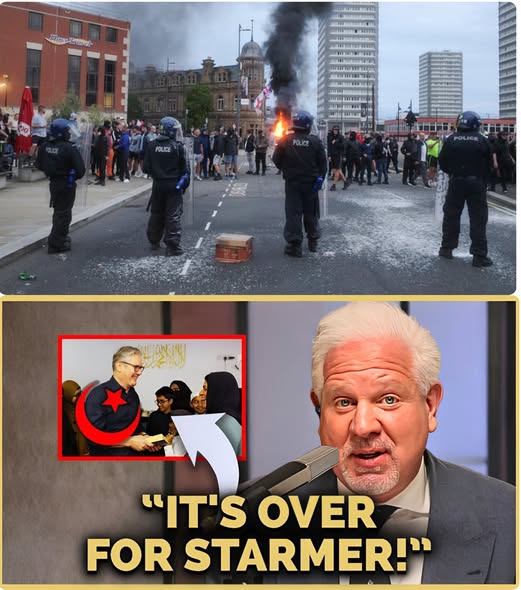
Glenn Beck: “Starmer Picked Islam Over Britain… Now He’s FINISHED!”
Britain, Free Speech, and the Fear of Cultural Decline: Why the Debate Around Keir Starmer Is Exploding
In recent months, political tensions in the United Kingdom have intensified as debates over immigration, national identity, Islam, free speech, and government authority dominate public discourse. A controversial interview featuring conservative commentator Glenn Beck and Dutch activist Eva Vlaardingerbroek reignited these conversations, accusing British Prime Minister Keir Starmer of suppressing dissent, restricting free speech, and prioritizing multicultural politics over traditional British identity.
The interview quickly spread across social media because it touched on subjects that many people across Europe and America are already deeply divided over. Supporters of the speakers argued that Western governments are increasingly hostile toward patriotism and conservative opinions. Critics, however, viewed the discussion as fear-driven rhetoric that unfairly portrayed immigrants and Muslims as threats to society.
Regardless of political perspective, the discussion reflects a broader crisis unfolding across the Western world: How can modern democracies balance free expression, immigration, national identity, and social cohesion without descending into polarization?
This article explores the themes raised in the interview while examining the political, cultural, and social realities behind the controversy.
The Growing Anxiety Over Free Speech in Britain
One of the strongest claims made during the discussion was that Britain is becoming hostile toward free speech, especially speech criticizing immigration or Islam.
Unlike the United States, the United Kingdom does not have a constitutional First Amendment guaranteeing almost unlimited speech protections. British law places greater emphasis on balancing freedom of expression with protections against hate speech, harassment, incitement, and threats to public order.
Critics argue that these laws have become increasingly broad and inconsistently enforced.
Over the last several years, a number of high-profile incidents in Britain sparked controversy:
- Citizens questioned by police over social media posts
- Arrests related to online harassment or offensive comments
- Demonstrations heavily monitored by authorities
- Increasing concerns about “non-crime hate incidents”
To many conservatives and libertarians, these developments suggest that the state is becoming too comfortable policing opinions rather than crimes.
Supporters of stricter speech laws disagree. They argue that governments have a responsibility to prevent hate campaigns, extremist incitement, and social unrest in increasingly diverse societies.
The divide between these two views represents one of the defining political battles of modern Europe.
Immigration and National Identity
Immigration remains one of the most emotional political subjects in Britain.
For years, many British citizens have expressed concerns about:
- Illegal migration
- Border security
- Housing shortages
- Pressure on public services
- Cultural integration
- Crime and community fragmentation
These concerns intensified after Brexit, which was driven in large part by demands for stronger national sovereignty and immigration control.
The interview repeatedly framed immigration as a threat to British identity. Glenn Beck and Eva Vlaardingerbroek argued that elites are weakening national pride while encouraging mass migration that changes the cultural fabric of society.
This viewpoint resonates with many Europeans who feel disconnected from political elites and frustrated by rapid demographic and social change.
However, critics of this narrative warn that such arguments can easily cross into broad generalizations about immigrants and Muslims. Britain’s immigrant population is extremely diverse, consisting of people from many ethnic, cultural, and religious backgrounds. Millions of immigrants and their children work, pay taxes, serve in public institutions, and identify strongly as British.
The real debate is not simply “pro-immigration” versus “anti-immigration.” Instead, it revolves around several complex questions:
- How much immigration is sustainable?
- What level of assimilation should societies expect?
- How should democracies preserve social cohesion?
- Can multiculturalism succeed long term?
- What happens when cultural values conflict?
These are legitimate political questions that democratic societies continue to struggle with.
Islam and the Western World
A major focus of the interview was the claim that Islamic values and Western civilization are fundamentally incompatible.
This argument has become increasingly common among nationalist and right-wing political movements across Europe.
Supporters of this view point to:
- Islamist terrorist attacks in Europe
- Extremist preaching
- Forced marriage and honor violence cases
- Gender inequality in some conservative religious communities
- Concerns about parallel societies forming in certain neighborhoods
Critics argue that governments often avoid discussing these issues openly for fear of being labeled racist or Islamophobic.
At the same time, many people believe the rhetoric used in conversations like this unfairly paints all Muslims as extremists or enemies of Western society.
The reality is more complicated.
Islam is practiced by nearly two billion people worldwide. Interpretations of Islam vary dramatically across countries, cultures, and individuals. Many Muslims living in Europe support democracy, secular law, women’s rights, and peaceful coexistence.
The central issue is not whether Muslims can live in Western societies. Millions already do successfully. The challenge arises when extremist ideologies reject democratic principles or seek to impose religious authority over secular law.
Western democracies therefore face a delicate balancing act:
- protecting religious freedom,
- confronting extremism,
- and maintaining equal application of secular law.
When these conversations become overly simplified, they often generate more fear and division rather than practical solutions.
The Rise of Populism in Europe
The interview reflects a larger populist wave sweeping across Europe.
Across multiple countries, nationalist and anti-establishment parties have gained support by campaigning on:
- stronger borders,
- opposition to globalization,
- criticism of political elites,
- resistance to progressive cultural policies,
- and defense of national traditions.
Figures like:
- Viktor Orbán,
- Geert Wilders,
- and Marine Le Pen
have all built movements around these themes.
Their supporters argue that traditional political parties ignored ordinary citizens for too long. They believe globalization enriched elites while weakening national identity, local industry, and cultural stability.
Opponents see these movements as dangerous forms of nationalism that exploit fear, immigration anxieties, and cultural tensions for political gain.
The truth is that populist movements often emerge when large groups of people feel unheard. Economic insecurity, rapid social change, distrust of institutions, and declining faith in government all contribute to political polarization.
Is Britain Becoming More Authoritarian?
One of the most dramatic claims in the interview was that Britain is turning into a country where citizens are jailed merely for disagreeing with the government.
That claim is exaggerated.
Britain remains a democratic country with:
- competitive elections,
- independent courts,
- opposition parties,
- a free press,
- and active political dissent.
People openly criticize the government every day.
However, concerns about government overreach are not entirely imaginary.
Many civil liberties organizations have warned that:
- surveillance powers,
- online speech policing,
- and expanded hate speech laws
can create a chilling effect on public debate.
Some critics argue that authorities sometimes apply these standards inconsistently, particularly around politically sensitive subjects such as immigration and religion.
The challenge for democratic societies is determining where to draw the line between:
- protecting public safety,
- and preserving open political discourse.
This debate exists not only in Britain, but throughout Europe and North America.
The “Globalist” Narrative
Another major theme in the interview was the idea that global elites are deliberately eroding national sovereignty and identity.
This narrative is extremely influential in populist politics.
Supporters claim that:
- international institutions,
- multinational corporations,
- unelected bureaucracies,
- and political elites
have become disconnected from ordinary citizens.
Brexit itself was fueled partly by this frustration, as many British voters opposed the influence of the European Union over national policymaking.
Critics of globalization argue that national governments increasingly surrender control over:
- borders,
- trade,
- speech regulation,
- and economic policy.
Opponents of this narrative caution that “globalist” rhetoric can become overly conspiratorial, especially when it suggests coordinated efforts to destroy nations or replace populations.
In reality, globalization is a complex economic and political process driven by technology, trade, migration, and international cooperation—not necessarily a centralized conspiracy.
Still, distrust of elites has undeniably become one of the strongest political forces in the modern world.
Why These Conversations Are Becoming More Intense
The emotional intensity surrounding these issues is not accidental.
Western societies are experiencing multiple simultaneous pressures:
- Economic inequality
- Rising housing costs
- Declining trust in institutions
- Rapid cultural change
- Social media polarization
- Immigration debates
- Security concerns
- Identity politics
As a result, people increasingly feel that their way of life is either under threat or unfairly criticized.
Conservatives often feel that:
- patriotism is mocked,
- traditional values are under attack,
- and national identity is disappearing.
Progressives often feel that:
- minorities are scapegoated,
- diversity is demonized,
- and fear-based politics are fueling intolerance.
Both sides frequently believe the other poses a danger to democracy itself.
This mutual distrust creates an environment where compromise becomes increasingly difficult.
America and Europe: Different Models of Free Speech
A major comparison in the interview involved the United States and Europe.
America’s free speech tradition is significantly broader than most European systems.
In the United States:
- offensive speech is usually protected,
- political speech receives extraordinary legal protection,
- and government restrictions on expression face very high constitutional barriers.
In much of Europe:
- hate speech laws are more extensive,
- historical sensitivities shape public policy,
- and governments place greater emphasis on protecting social harmony.
Supporters of the American model argue that free societies must tolerate even deeply offensive opinions.
Supporters of the European model argue that unrestricted speech can contribute to extremism, radicalization, and violence.
Neither system is perfect. Both involve trade-offs between liberty and social stability.
The Role of Media and Online Personalities
Interviews like this gain enormous traction because modern media ecosystems reward emotional and dramatic content.
Political commentators increasingly compete for attention through:
- outrage,
- fear,
- strong identity narratives,
- and emotionally charged language.
Terms like:
- “civilizational collapse,”
- “globalist takeover,”
- “Islamization,”
- or “tyranny”
generate powerful emotional reactions online.
This does not mean every concern raised is invalid. Some issues discussed—such as integration challenges, free speech concerns, and distrust of elites—reflect real public anxieties.
But highly emotional framing can also:
- deepen polarization,
- encourage hostility,
- and reduce complex problems into simplistic narratives.
The result is a political environment where fear often spreads faster than nuanced discussion.
Can Western Democracies Hold Together?
The deeper question beneath all of these debates is whether Western democracies can maintain unity in increasingly divided societies.
Many people fear:
- cultural fragmentation,
- political extremism,
- economic instability,
- and declining trust in democratic institutions.
Others fear the rise of authoritarian nationalism, xenophobia, and attacks on minority rights.
The survival of democratic societies likely depends on balancing several difficult principles simultaneously:
- freedom of expression,
- national identity,
- equal citizenship,
- religious liberty,
- democratic accountability,
- and social cohesion.
If governments suppress legitimate public concerns, resentment grows.
If political movements demonize entire religious or ethnic groups, social trust collapses.
Democracies function best when citizens can openly debate difficult issues without resorting to hatred, censorship, or conspiracy thinking.
Conclusion
The controversy surrounding Glenn Beck’s interview with Eva Vlaardingerbroek reveals a much larger political and cultural struggle unfolding across the Western world.
Questions about immigration, free speech, national identity, Islam, globalization, and democracy are no longer fringe issues. They now sit at the center of political life in Europe and America.
Many citizens genuinely worry that their traditions, freedoms, and national identities are changing too rapidly. Others fear that growing nationalism and anti-immigrant rhetoric threaten pluralism and democratic values.
Both fears are real.
The challenge for modern democracies is finding a path that preserves:
- open debate,
- social stability,
- equal rights,
- and democratic legitimacy
without allowing polarization to destroy public trust entirely.
The future of Western societies will likely depend not on silencing disagreement, but on learning how to manage profound disagreement without turning political opponents into enemies.