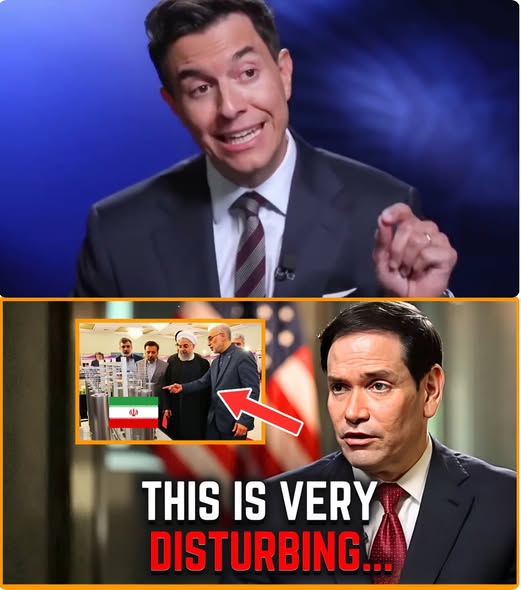
Marco Rubio Warns of a Dangerous Global Turning Point as Iran Pushes Toward Nuclear Power
For years, the world has lived under a fragile illusion that the greatest geopolitical threats could somehow be managed indefinitely through diplomacy, sanctions, and carefully worded statements. But according to Marco Rubio, that illusion is beginning to collapse.
In a striking interview discussing Iran, China, the Strait of Hormuz, and America’s role in the world, Rubio laid out a vision of global politics that is far more serious than many Americans fully realize. His warning was direct: Iran is not simply pursuing influence in the Middle East. It is positioning itself to become a nuclear-backed power capable of threatening global commerce, energy markets, and international stability itself.
And in Rubio’s view, the danger is not theoretical anymore.
The conversation revealed something deeper than a typical foreign policy debate. It exposed a growing realization inside Washington that the conflict surrounding Iran is no longer just about one nation or one region. It is about the future balance of power in the world, the survival of international order, and whether the United States still has the will to defend the principles that shaped the modern era.
The Strait of Hormuz: The World’s Most Dangerous Pressure Point
One of the central issues Rubio discussed was the Strait of Hormuz — the narrow but critically important waterway through which a massive portion of the world’s oil supply travels every single day.
For decades, analysts have warned that Iran could attempt to weaponize the strait during a major confrontation. Rubio argues that this is no longer merely a hypothetical scenario. According to him, Iran has already begun moving toward a strategy of militarization and economic coercion.
Rubio described Iran’s actions as an effort to turn an international waterway into something controlled by Tehran itself. He accused the regime of attempting to impose a de facto toll system on global shipping while threatening commercial vessels that refuse to comply.
If true, the implications are enormous.
The Strait of Hormuz is not simply important to America. It is essential to Europe, Asia, and much of the developing world. A disruption there would impact oil prices, shipping costs, inflation, supply chains, manufacturing, and consumer prices across the globe almost overnight.
Rubio’s argument is simple but powerful: no nation can be allowed to hold the global economy hostage.
That is why he repeatedly emphasized that the issue extends beyond U.S. national interests. In his framing, this is about preserving the principle of free navigation and maintaining the stability of the international system itself.
Why Iran’s Nuclear Program Changes Everything
At the heart of Rubio’s warning lies Iran’s nuclear ambitions.
Rubio made clear that nearly every major nation publicly agrees that Iran should not possess nuclear weapons. Even China, he noted, has repeatedly stated that it opposes a nuclear-armed Iran because Tehran is technically bound by the Nuclear Non-Proliferation Treaty.
But Rubio believes there is a major difference between countries that merely oppose Iran’s nuclear ambitions rhetorically and countries willing to actively stop them.
According to Rubio, Iran’s strategy is not simply to build a bomb. It is to create enough military leverage — through missiles, drones, proxy forces, and regional intimidation — that no outside power would dare interfere with its nuclear development once it reaches a critical threshold.
This is the key strategic concept he repeatedly returned to during the interview.
Iran, in Rubio’s view, has been attempting to build what he described as a “conventional shield” around its nuclear program. By stockpiling massive quantities of missiles and drones, Tehran seeks to create a situation where retaliation against its nuclear infrastructure would become too costly or too dangerous for the international community.
In essence, Rubio is arguing that Iran does not merely want nuclear capability for deterrence. It wants immunity.
And once a regime gains that level of protection, everything changes.
Why China Suddenly Matters in the Iran Crisis
Perhaps the most fascinating aspect of the interview was Rubio’s discussion of China.
For years, U.S.-China relations have been defined by competition, mistrust, and strategic rivalry. Rubio himself has long been one of the strongest critics of Chinese influence, warning repeatedly about supply chain dependence, intellectual property theft, surveillance technology, and Beijing’s military ambitions.
Yet in this interview, Rubio acknowledged something surprising: China and the United States may currently share at least one critical interest.
Neither wants Iran to destabilize the Strait of Hormuz.
This matters because China depends heavily on Middle Eastern energy imports. If Iran successfully militarizes the strait or disrupts oil shipments, China’s economy would suffer alongside the rest of the world.
Rubio emphasized that America is not “asking” China for help. Instead, he suggested the United States is making its position unmistakably clear while testing whether Beijing is willing to behave as a responsible global power when confronted with genuine international instability.
That subtle distinction matters enormously.
Rubio is effectively presenting a geopolitical framework in which great power competition does not eliminate the possibility of limited strategic alignment when civilization-level interests are at stake.
This is not friendship. It is not trust. It is not alliance.
It is realism.
And realism increasingly defines the modern world.
America’s Real Fear: A Nuclear Iran Protected by Economic Leverage
One of the strongest moments in Rubio’s interview came when he explained why a nuclear Iran would be uniquely dangerous.
Many people think of nuclear weapons purely as military tools. Rubio argues that Iran would use them differently — as political leverage.
Imagine a regime capable of threatening global energy supplies while also operating under the protection of nuclear deterrence.
According to Rubio, that combination would fundamentally alter global politics.
He warned that if Iran eventually acquires nuclear weapons, the current crisis in the Strait of Hormuz could become permanent rather than temporary. A nuclear-backed Iran could potentially pressure shipping lanes, intimidate neighboring countries, and manipulate oil markets while making military intervention extraordinarily risky.
This is why Rubio insists the issue cannot simply be delayed or managed indefinitely.
In his view, the stakes are too high.
The Return of American Deterrence
Throughout the interview, Rubio repeatedly stressed the importance of clarity and strength.
He argued that America’s enemies exploit hesitation and confusion while respecting firm resolve. In his telling, the current administration’s actions toward Iran are designed not to provoke war, but to prevent larger catastrophes later.
This distinction is important because Rubio framed American power not as imperial ambition but as stabilizing force.
According to him, the United States is attempting to preserve an international system where trade routes remain open, regional powers cannot dominate smaller neighbors through intimidation, and nuclear proliferation remains constrained.
Critics may disagree with Rubio’s conclusions or methods, but his worldview is internally coherent. He sees American leadership as essential to maintaining global order, particularly when authoritarian regimes test international norms.
That perspective reflects a long tradition in American foreign policy stretching across multiple administrations and political parties.
Why the Economic Pressure Is Growing
One reason this crisis feels increasingly urgent is because ordinary Americans are already feeling its economic impact.
Higher oil prices ripple through every part of the economy. Gas prices rise. Airline tickets become more expensive. Shipping costs increase. Consumer goods become more costly. Inflation pressures intensify.
Rubio acknowledged these realities directly.
He admitted that disruptions in the Strait of Hormuz affect U.S. consumers, even though America produces substantial amounts of its own energy. Because oil markets are global, instability anywhere can quickly influence prices everywhere.
This creates enormous political pressure domestically.
Americans may support preventing Iran from obtaining nuclear weapons in principle, but support becomes harder to maintain when economic pain increases at home.
Rubio appeared fully aware of this challenge. Yet he argued that allowing Iran to succeed would create even worse long-term consequences.
In his reasoning, temporary pain now may prevent far greater instability later.
Diplomacy Versus Military Pressure
A major theme throughout the conversation was the tension between diplomacy and force.
Rubio repeatedly emphasized that President Trump prefers a diplomatic solution. He described previous military operations as limited actions designed to weaken Iran’s military capabilities while creating space for negotiations.
At the same time, Rubio made clear that diplomacy alone cannot succeed unless backed by credible pressure.
This reflects a classic “peace through strength” doctrine: negotiations work best when adversaries believe the alternative could be worse.
Rubio also suggested that Iran’s internal divisions are complicating negotiations. According to him, Iranian negotiators often require days to obtain approval from competing power centers within the regime.
That detail is important because it portrays Iran not as a unified actor but as a fractured system struggling to coordinate its own responses under intense pressure.
Such instability can make diplomacy both more necessary and more dangerous at the same time.
The Bigger Question: What Role Should America Play?
Beneath all the discussion about Iran lies a deeper philosophical debate.
Should America continue acting as the primary defender of the global order?
Rubio’s answer is clearly yes.
He framed the United States not simply as another nation pursuing narrow self-interest, but as a country built around universal ideals — freedom, dignity, constitutional government, and individual rights.
According to Rubio, those ideals remain globally significant despite America’s flaws.
He argued that dictatorships still fear American influence because the United States represents something fundamentally different from systems built on authoritarian control.
This is where Rubio’s argument becomes more moral than strategic.
He is not merely saying America is powerful.
He is saying America still matters.
And in moments of global uncertainty, that distinction becomes incredibly important.
The Spiritual Dimension of Western Civilization
Toward the end of the interview, the conversation shifted into broader reflections about Western civilization itself.
Rubio and the interviewer discussed the idea that America’s strength ultimately depends not only on military capability or economic power, but on moral confidence.
This argument has become increasingly common among conservative thinkers who believe modern Western societies are experiencing internal cultural weakening alongside external geopolitical threats.
The concern is not simply about foreign enemies.
It is about whether Western nations still believe strongly enough in their own values to defend them.
Rubio connected American identity to ideas such as freedom under God, human dignity, responsibility, and constitutional liberty. In his view, civilizations collapse not merely because of military defeat, but because they lose faith in their own purpose.
Whether one agrees with that interpretation or not, it reveals something important about the mindset shaping parts of America’s foreign policy establishment today.
For many policymakers, the conflict with authoritarian powers is not purely geopolitical.
It is civilizational.
Why This Moment Feels Different
There have been countless Middle East crises over the past several decades. Yet this moment feels different for several reasons.
First, the world economy is already fragile after years of inflation, supply chain disruptions, debt expansion, and geopolitical instability.
Second, multiple global flashpoints now intersect simultaneously: Iran, China, Russia, Taiwan, Ukraine, energy markets, cyber warfare, and global trade routes.
Third, technological warfare has changed dramatically. Drones, missiles, cyber attacks, and asymmetric tactics allow regional powers to create disproportionate disruption at relatively low cost.
And finally, public trust in institutions across the West has weakened considerably, making unified political responses more difficult.
Rubio’s interview reflected all of these realities.
His message was ultimately about preparedness — mentally, politically, economically, and strategically.
The Future of American Leadership
Whether one agrees with Rubio or not, his interview captured a growing belief among many Americans that the world is entering a more dangerous era.
The post-Cold War assumption that globalization alone would produce stability is fading rapidly. Great power competition has returned. Regional conflicts now carry global economic consequences. Energy security once again dominates strategic calculations.
And in this environment, America faces a defining question:
Will it continue leading the international order, or retreat from that responsibility?
Rubio clearly believes retreat would create a vacuum filled by authoritarian powers willing to use coercion and instability for strategic gain.
His critics may argue that interventionism creates its own dangers.
But even they increasingly acknowledge that the world is becoming less stable, not more.
That may be the most important takeaway from this entire discussion.
The debate is no longer about whether global tensions exist.
The debate is about how democracies respond to them.
Conclusion: A World Standing at the Edge of Transformation
Marco Rubio’s warnings about Iran are ultimately about far more than one country’s nuclear ambitions.
They are about the fragility of global order itself.
The Strait of Hormuz, China’s calculations, rising oil prices, military deterrence, diplomacy, sanctions, and nuclear proliferation are all connected pieces of a much larger puzzle.
At stake is whether international norms still mean anything in a world increasingly shaped by power politics and strategic coercion.
Rubio’s central argument is that weakness invites aggression while clarity preserves peace.
History will determine whether that assessment proves correct.
But one thing is undeniable: the geopolitical era now emerging is far more volatile than the one many believed would define the 21st century.
And as tensions rise between freedom and authoritarianism, between stability and chaos, between deterrence and escalation, the choices made by world leaders in the coming months may shape the future for decades to come.
America, China, Iran, and the rest of the world are now locked together in a high-stakes test of resolve, diplomacy, and power.
The outcome remains uncertain.
But the consequences will be global.