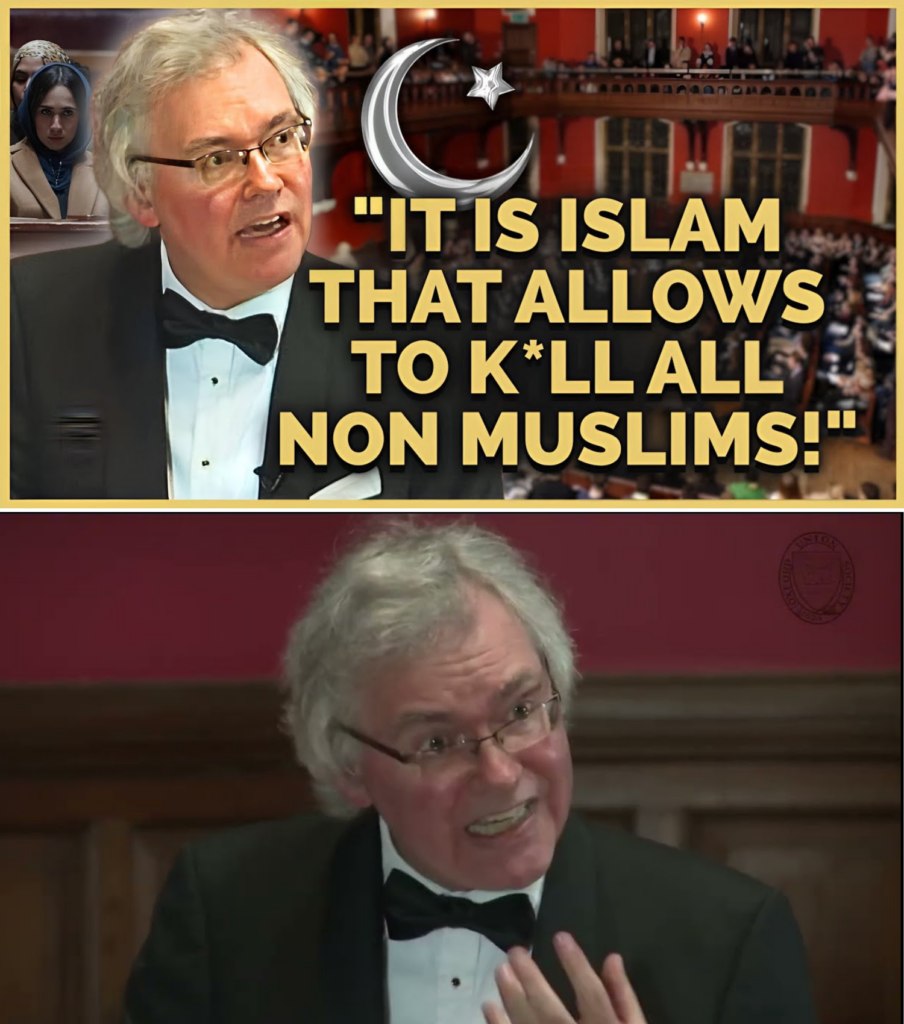
The Oxford Debate: Daniel Johnson and the Uncomfortable Questions About Islam
Preview: In a historic and intensely charged appearance at the Oxford Union, journalist Daniel Johnson challenged the notion of Islam as a “religion of peace.” His bracing argument, which focused on the necessity of intellectual freedom and the dangers of fundamentalism, left the audience in a profound, heavy silence.
The Oxford Union, a bastion of free speech and rigorous intellectual inquiry, recently played host to a debate that captured the simmering tensions regarding the place of Islam in modern Western society. British journalist Daniel Johnson, known for his incisive critiques of ideological movements, stood before a packed house to deliver a speech that defied the standard platitudes often heard in such forums.
The Cost of Inquiry
Johnson’s opening remarks were stark, delivered against the somber backdrop of recent violence on the streets of London. Rather than avoiding the controversy, he centered his argument on the chilling effect that fear has had on academic and public life. He recounted his personal encounters with individuals who have been forced into hiding or subjected to violence simply for questioning the tenets of Islam or for their perceived political identity.
His central premise was simple but explosive: a society’s greatness is measured by its capacity for self-criticism, and he argued that the modern Islamic world—and by extension, the academic discourse surrounding it—is currently suffering under a regime of intellectual suppression.
Apostasy, Blasphemy, and the West
Johnson’s analysis delved into the historical and theological mechanisms he believes have inhibited the development of Islamic thought. Comparing the evolution of Judeo-Christian traditions—which underwent centuries of reformation, Enlightenment, and self-reflection—to contemporary Islamic doctrine, Johnson argued that the latter has remained stifled by a rigid, literalist interpretation.
He famously noted that the scholarly work of his late friend, Professor Geza Vermes, would have been impossible within the borders of an Islamic state. To Johnson, the execution of intellectuals for “blasphemy” or “apostasy” is not merely a tragedy for those individuals; it is the fundamental reason why the Islamic world lacks the kind of vibrant, autonomous universities that define Western freedom.
A Call for Evolution
Johnson’s argument was not merely a historical critique; it was a challenge to the present. He contended that Islam could indeed evolve, but only if it embraces the freedoms of speech, press, and conscience that the West takes for granted. He called on Muslim authorities to step out from behind the veil of “Islamophobia” to address the “dirty little secret” of routine discrimination and antisemitism within their own communities.
He drew a hard line between traditional faith and what he termed “Islamism”—a fundamentalist wave that he claims has hijacked the religion and transformed it into a vehicle for geopolitical dominance and terror.
A Stunned Audience
The reaction in the chamber was palpable. As Johnson laid out the stark realities of his thesis—insisting that until radicalism is purged from its ranks, the “religion of peace” label rings hollow—the room fell into a heavy, resonant silence. It was a silence that spoke to the gravity of his words and the difficulty of the questions he posed.
Johnson’s debate performance serves as a flashpoint in the broader cultural conversation. Whether viewed as a necessary, brave challenge to institutional stagnation or a provocative broadside against a global faith, his words have forced an uncomfortable debate into the light. In an age of increasing polarization, Johnson’s message remains clear: the preservation of free inquiry is not just a Western luxury, but the primary safeguard of civilization itself.